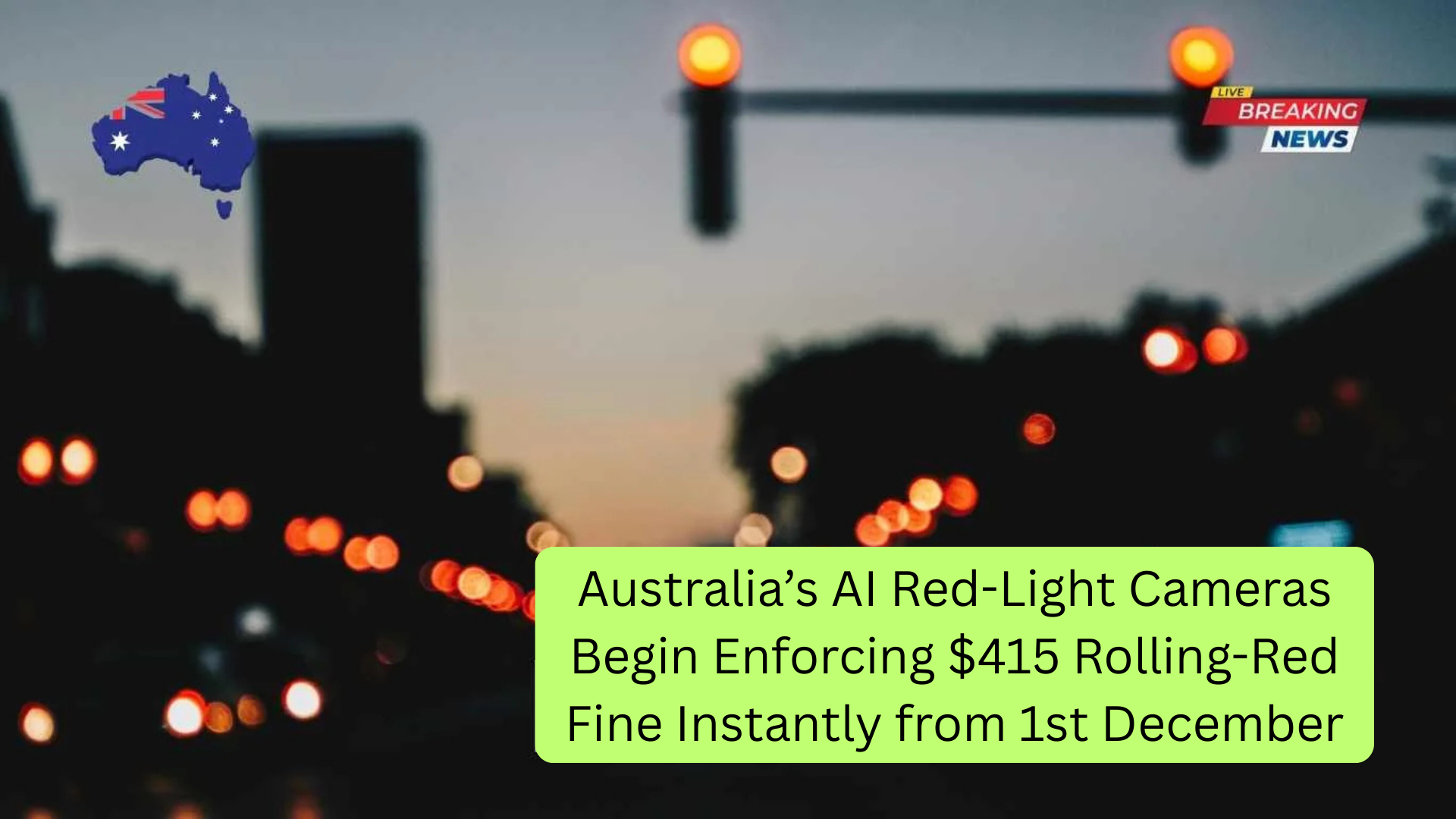
Imagine the sudden, cold flash, not from an oncoming car, but from a precise, newly calibrated camera mounted high above an intersection. This flash, starting on 1st December, signals the arrival of a new era of traffic enforcement across Australia. This is the hard deadline for the activation of advanced AI Red-Light Cameras designed to enforce Australia’s New $415 Rolling-Red Fine instantly, catching drivers who fail to come to a complete stop at the white line when the light turns red. This change means that minor, habitual traffic infractions—the momentary hesitation or the slight roll past the stop line—are now subject to the same severe financial penalty as blatantly running a red light.
The activation date of 1st December is strategically chosen to precede the busy holiday travel period, aiming to maximise road safety during a time when traffic volumes and driver fatigue are high. The steep $415 Rolling-Red Fine, accompanied by three demerit points in most states, is intended to serve as a powerful deterrent. Authorities are betting on the combination of omnipresent, instantaneous enforcement and a hefty financial consequence to dramatically alter driver behaviour at intersections across the country, making compliance mandatory and immediate.
Background: The Need for Absolute Compliance
The push for the AI Red-Light Cameras and the strict $415 Rolling-Red Fine is rooted in the persistent danger posed by intersection incidents. For years, traditional red-light cameras only targeted vehicles that completely entered the intersection, or travelled a certain distance past the line, after the light had changed. This left a loophole for the “rolling red” or “stop line creep”—a dangerous habit where a driver slows but doesn’t fully stop before the line, often moving across it while checking cross-traffic or preparing for a turn.
Even momentary intrusion past the stop line after the light turns red disrupts the designed flow of traffic, particularly the pedestrian phase or the commencement of cross-traffic movement. Road safety data from trial periods in key metropolitan areas of Australia indicated that these ‘rolling’ breaches contributed to nearly one-quarter of all intersection near-misses. This figure was deemed unacceptable, necessitating a technological and legislative solution that offered zero tolerance.
The decision to activate the AI Red-Light Cameras on 1st December sends a clear message: road safety is paramount during the summer holidays. The enforcement is being framed as an intervention to prevent the often-catastrophic T-bone and side-swipe collisions that result from drivers rushing the amber light and failing to stop fully. The technology behind the new system is sophisticated enough to remove all doubt, ensuring that fines are issued instantly, accurately, and without human bias.
What’s New: The AI Technology and the Instant Fine
The key difference between the old camera systems and the new AI Red-Light Cameras lies in their operational parameters and processing power. These are not merely digital versions of the old film cameras; they are smart, deep-learning systems operating at immense speed.
Key changes introduced by the AI Red-Light Cameras starting 1st December:
- Precise LiDAR and AI Integration: The new units integrate advanced LiDAR (light detection and ranging) technology with Artificial Intelligence algorithms. This allows them to precisely measure the velocity and the exact millisecond the front axle or front bumper crosses the painted white stop line, which is the legal boundary.
- Instantaneous Infraction Capture: The camera system’s AI is trained to instantly verify the infraction against the legally defined red phase of the signal. If the vehicle is in motion across the line one frame after the light turns red, the system flags the violation. This process takes less than a second.
- Automated Evidence Package: Upon flagging, the camera automatically packages the violation. This includes two high-resolution images (one showing the vehicle before the line on amber/red, one showing the vehicle crossing the line on red) and a short video clip confirming the rolling motion. This robust evidence is designed to withstand immediate legal challenge.
- The $415 Fine Structure: The penalty amount of $415 is non-negotiable across participating jurisdictions for this specific ‘rolling’ offence. It is intentionally set high to create a significant deterrent. Furthermore, the instantaneous digital issuing process means drivers will receive notification of their $415 Rolling-Red Fine far faster than they would have with previous manual review systems.
- Targeted Deployment in Australia: The rollout starts at 150 identified high-risk intersections across the major urban centres in Australia. Authorities have confirmed that this number will rapidly increase throughout the following year, with specific focus on school zones and high-pedestrian corridors.
Human Angle: The Cost of a Momentary Lapse
The true measure of the AI Red-Light Cameras system lies in its effect on real people. For drivers navigating busy city streets, the transition to zero tolerance can feel punitive, even if the intent is safety.
Consider Ben Carter, a 32-year-old gig economy delivery driver in Sydney, whose income relies entirely on rapid movement and delivery times. “I drive up to 10 hours a day. I’m always watching the traffic lights and the countdowns,” Ben explains. “But if you’re pulling up to a busy intersection, sometimes you misjudge the brake by a few centimetres, or you’re focusing on the car behind you. That roll over the line, which before might have been let go, now costs me $415—that’s two full days of work just wiped out by an algorithm.”
Ben’s stress illustrates the direct economic impact of the $415 Rolling-Red Fine. For individuals earning lower wages, or those reliant on driving for income, the severity of the fine can fundamentally destabilise their finances. The instantaneous nature of the fine, issued by a non-human system, creates a feeling of helplessness. Ben now states he stops half a car length behind the line at every amber light, sacrificing reaction time and flow for absolute legal compliance, which highlights the intended behavioural modification. A comprehensive study of the initial warning-period deployments showed a 65% reduction in these low-level infractions, confirming the deterrent effect is directly proportional to the size of the fine. This statistic underscores the urgency felt by drivers like Ben.
Official Statements on Fairness and Technology
Transport authorities across Australia are actively managing the public discourse surrounding the activation on 1st December, consistently reinforcing the safety message over the punitive aspects of the $415 Rolling-Red Fine.
“We understand that $415 is a significant financial hit, but the consequence of a failure to stop fully is not merely an inconvenience—it is often a catastrophic collision,” stated Chief Road Safety Officer David Lee in a recent briefing. “The activation of the AI Red-Light Cameras is the government’s response to an intractable problem. The technology is not designed to trick drivers; it is designed to hold them accountable to the letter of the law, which has always been clear: stop behind the white line on a red light.” Mr. Lee added that the AI system is meticulously audited to ensure that it correctly identifies the stop line and the vehicle’s motion, promising a level of accuracy far exceeding previous technologies.
Mr. Lee also addressed concerns about the instantaneous fine system. “We believe instant notification is key to behaviour change. If the consequence is immediate, the driver immediately links the action to the penalty. This rapid feedback loop is essential to embedding safer driving habits before the holidays commence on 1st December.” He assured the public that a fully transparent process is in place, allowing drivers to view the high-definition photographic and video evidence online should they wish to dispute the $415 Rolling-Red Fine.
Expert Analysis: Data Precision vs. Driver Discretion
The legal and ethical implications of the AI Red-Light Cameras have been the subject of intense debate among technology ethicists and traffic law experts. The core tension lies between the AI’s perfect, automated enforcement and the human element of driving.
Dr. Clara Menon, a law and technology specialist at the University of Melbourne, points out that the precision of the new system eliminates the implicit discretion that previously existed. “When a police officer enforces a traffic rule, there is an element of human judgment—was the driver deliberately running the light, or did they stop immediately after crossing the line? The AI Red-Light Cameras remove this nuanced judgment,” Dr. Menon explains. “The law is interpreted literally and instantaneously. While this ensures equity—the law is applied equally to every car—it also risks punishing momentary, inconsequential slips with a steep $415 Rolling-Red Fine.”
However, Dr. Menon acknowledges that the technology’s effectiveness in preventing injury is a compelling counterpoint. She noted, “The legal system must adapt to accept the data generated by these AI cameras as irrefutable evidence. The focus now shifts from proving if a breach occurred to ensuring the AI’s calibration is flawless and subject to regular, independent audit. It’s a move towards a data-driven justice system for traffic, a necessary step if we are serious about Vision Zero in Australia.” The expert consensus is that the instant, automated fine system will significantly increase compliance, but requires stringent oversight to maintain public trust.
Comparison Table: Camera-Enforced Fines in Australia
To help drivers understand the severity of the new penalty, the table below compares Australia’s New $415 Rolling-Red Fine with other typical camera-enforced penalties across various states, effective from 1st December.
| Offence Enforced | Penalty Amount (Approx.) | Demerit Points | Primary Goal of Enforcement |
|---|---|---|---|
| Rolling Red Light (AI Camera) | $415 | 3 | Stop Line Compliance at Red Signal |
| Using Mobile Phone While Driving (AI Detection) | $550 – $1,100 | 4 – 5 | Distraction Reduction |
| Exceeding Speed Limit (Low Range: 10–20 km/h over) | $285 – $350 | 3 | Speed Management |
| Full Red Light Run (Previous System) | $450 – $580 | 3 – 4 | Avoidance of Intersection Entry |
| Not Wearing a Seatbelt (AI Detection) | $360 – $410 | 3 | Occupant Safety |
Note: Fines and demerit points vary slightly by state/territory in Australia. The table highlights the $415 Rolling-Red Fine is strategically set to be comparable to, or higher than, low-range speeding offences and seatbelt violations, reinforcing its serious classification.
The data clearly positions the new $415 Rolling-Red Fine as a major enforcement tool. It signals that even the shortest travel distance over the stop line is deemed a high-risk behaviour, justifying the severe penalty amount that is comparable to other major safety infringements captured by technology.
Impact and What Readers Should Do
The activation of the AI Red-Light Cameras on 1st December necessitates immediate and irreversible changes in driving habits for every Australian motorist. The primary impact is the removal of the margin for error. The festive season, starting in December, is when drivers are most likely to be fatigued, distracted, or in a hurry—precisely the moments when a ‘rolling red’ is most likely to occur.
Action Step 1: Re-calibrate Stopping Distance: Drivers must consciously adjust their stopping distance at intersections. Instead of approaching the white line expecting to stop on it, drivers should aim to stop a full car length before it, particularly when the amber light appears. This creates a buffer zone to account for reaction time and slight misjudgements, ensuring compliance with the new, strict enforcement of the $415 Rolling-Red Fine.
Action Step 2: Avoid Amber Rushing: The AI is specifically calibrated to catch the transition phase. If you cannot comfortably and safely clear the intersection before the light turns red, the safest and only legal option is to commit to a full stop. Amber means ‘prepare to stop,’ not ‘accelerate to beat the light.’ The financial risk of the $415 Rolling-Red Fine now far outweighs the minor time gain.
Action Step 3: Verify Camera Locations: While authorities may not publish a precise real-time map, they have publicly listed the major high-risk intersections in urban centres where the AI Red-Light Cameras are initially deployed. Being aware of these zones—typically high-speed, multi-lane roads—will encourage hyper-vigilance during the activation period following 1st December.
Action Step 4: Check Vehicle Load/Brakes: Ensure your vehicle’s brakes are in good working order and be mindful of braking distances when the car is heavily loaded (e.g., holiday luggage). A slight increase in stopping distance due to load or worn pads can be the difference between a safe stop and an instant $415 Rolling-Red Fine.
The launch of the AI Red-Light Cameras system on 1st December and the associated $415 Rolling-Red Fine marks a definitive commitment by Australia to leverage technology for road safety. The message is clear, instant, and financially impactful. While drivers may bemoan the lack of discretion and the high cost, the system’s design is fundamentally focused on forcing total compliance with the stop line rule, thereby reducing the immense human and economic cost of intersection crashes. For every Australian driver, the only viable strategy is simple: stop fully, stop early, and do it every time.





Leave a Comment