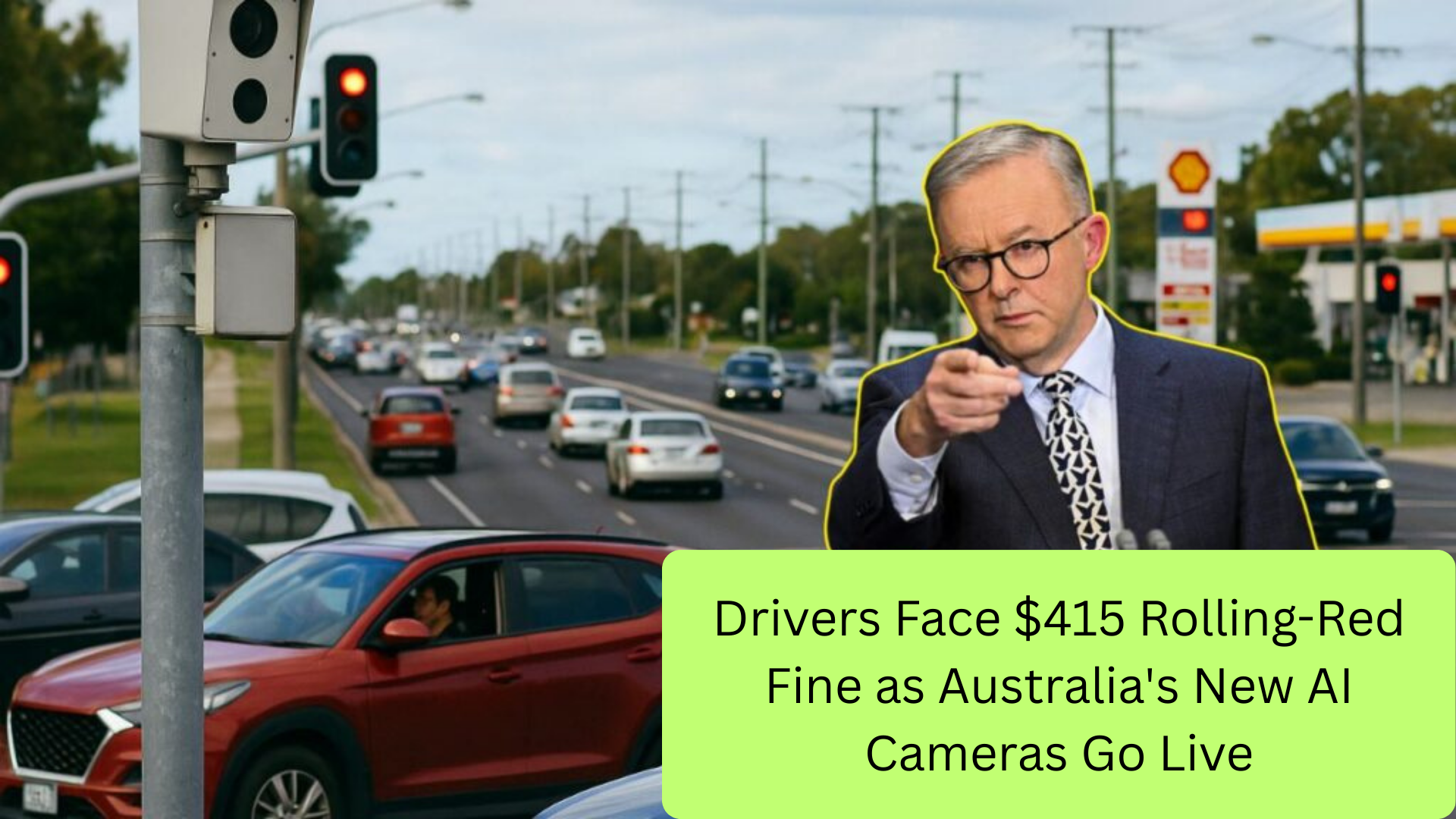
Imagine the gut-wrenching moment: you approach a traffic light, slightly distracted, and try to beat the change. You slow down, but your front wheels inch over the white stop line just milliseconds after the light shifts from amber to red. A sharp, almost invisible flash confirms your mistake. Now, instead of a traditional red-light camera ticket, a new, highly precise $415 Rolling-Red Fine System is responsible for the instant breach. This is the new reality for drivers across Australia as state and territory governments roll out advanced New AI Cameras capable of nailing drivers instantly, even for minor infractions, starting in 2025.
This deployment signals a massive shift in road enforcement strategy. The focus is no longer just on high-speed blatant running of a red light. Instead, the New AI Cameras are calibrated to catch what is known as a “rolling red”—where a vehicle fails to come to a complete stop behind the white line once the light illuminates red. The penalty is severe: a steep fine of $415 and three demerit points in many jurisdictions, reflecting the seriousness with which authorities view the infraction. This aggressive new system is set to be a key tool in Australia’s efforts to reduce road trauma this year.
Background: Why the System is Happening
The implementation of the $415 Rolling-Red Fine System is driven by a stark reality: intersections remain one of the most dangerous points on Australia’s road network. While overall road fatalities have seen periods of decline, serious injuries at intersections—particularly those caused by vehicles failing to stop or rushing the amber phase—remain stubbornly high. Traditional camera systems lacked the precision or the legal framework to enforce the ‘rolling’ offence consistently, often relying only on vehicles proceeding fully through the intersection.
The road safety experts behind the initiative cite extensive data showing that even a minor intrusion into the intersection during the red cycle creates a significant risk. It confuses oncoming traffic, pedestrians preparing to cross, and drivers turning right who expect the intersection to be clear. This small transgression—the ‘rolling red’—is viewed as symptomatic of a wider lack of driver attention and respect for clear right-of-way rules. Authorities estimate that these minor red-light breaches contribute to up to 15% of all intersection-related near-miss incidents in major metropolitan areas across Australia.
The current national road strategy in Australia emphasizes Vision Zero, aiming for zero fatalities and serious injuries. To achieve this ambitious goal, enforcement must evolve. The decision to invest heavily in New AI Cameras is fundamentally about changing driver behaviour at a micro-level, forcing compliance with the stop line rule, rather than just punishing extreme violations. The substantial $415 fine is designed to act as a powerful financial deterrent.
What’s New: Key Changes in Technology and Enforcement
The core of the new enforcement strategy is the sophisticated integration of Artificial Intelligence into existing and new roadside camera hardware. This is not the same technology used a decade ago; it is a system trained on millions of traffic scenarios to differentiate a genuine stop from a “rolling” movement.
Key changes introduced by the $415 Rolling-Red Fine System:
- AI-Powered Detection: The New AI Cameras utilise deep learning models to process video feeds at 60 frames per second. This allows them to precisely track the vehicle’s speed and position relative to the solid white stop line at the moment the traffic signal transitions to red.
- Zero-Tolerance Rolling Rule: The system enforces a near-zero-tolerance policy on the “rolling red” infraction. The camera is not triggered by the vehicle entering the intersection, but by the front axle or nose of the vehicle crossing the stop line after the light has turned red, even if the driver immediately brakes and reverses.
- High-Definition Evidence: The system captures both high-resolution still images and a short video clip of the entire sequence—from amber light, to red light, to the infraction itself. This robust evidence package is intended to minimise disputes and confirm the integrity of the AI Cameras’ detection.
- Instant Verification: Unlike older systems that require human review of every potential violation, the AI can pre-validate a high percentage of the offences. This streamlines the issuance of the $415 Rolling-Red Fine, making the penalty almost instantaneous and drastically reducing the time between the offence and the driver receiving the notification.
- Phased Rollout in Australia: The rollout in 2025 is phased. Initial deployment focuses on high-risk, high-traffic intersections in capital cities, where the most intersection-related incidents are recorded. The system will then expand to regional hubs and major arterial roads throughout the following year.
Human Angle: The Weight of a $415 Fine
The financial and psychological impact of the $415 Rolling-Red Fine is significant, particularly for low-to-middle-income Australians. Sarah Olsen, a 42-year-old aged care worker in Melbourne, found herself on the receiving end of a warning during the initial testing phase of the new system. Her near-miss illustrates the tight margins of the new enforcement.
“I was running late for a shift, trying to catch the tail end of the amber light, and I just misjudged it by a hair,” Sarah recounts. “I thought I braked in time, but the camera flash went off as my front bumper just cleared the white line. I received a warning letter that stated if the system was live, it would have been a $415 Rolling-Red Fine and three points. That amount is a week’s worth of groceries for me and my two kids.”
The sheer size of the fine—which rivals penalties for high-range speeding offences in some areas—makes the transgression feel disproportionately harsh to some drivers, even if they acknowledge the safety principle. For many families, an unexpected $415 deduction from the household budget can trigger serious financial strain, potentially affecting bill payments or debt management. Sarah now admits to stopping almost a full car length behind the line, a psychological shift enforced by the fear of the AI’s precision. This illustrates the effectiveness of the deterrent, even if it comes with anxiety.
Official Statements on Safety and Technology
Road safety officials have been unambiguous about the motivation behind the $415 Rolling-Red Fine System and the New AI Cameras. The focus, they insist, is squarely on preventative safety, not revenue generation.
“We recognise that $415 is a significant penalty, but it reflects the significant risk posed by moving through any part of an intersection on a red light,” stated Transport Minister Olivia Thorne in a public address regarding the 2025 deployment. “We are leveraging the best available technology to eliminate dangerous habits. The AI doesn’t have emotions or discretion; it simply enforces the law as it is written. If you stop behind the white line, you will never receive a fine.” The Minister stressed that the system’s primary metric for success will be the reduction in side-impact crashes at monitored intersections over the next three years.
A spokesperson for the state’s road authority added that the system is calibrated to ensure fairness and accuracy. “The margin for error is statistically negligible. Before any fine is issued, the AI’s detection is cross-referenced with laser rangefinders embedded in the camera housing,” the spokesperson confirmed. “This dual verification method ensures that drivers are penalised only when the vehicle is definitively in motion across the prescribed boundary after the change to red light. Furthermore, the video evidence is available for review during the appeal process, maintaining transparency.”
Expert Analysis: The Ethics of AI Enforcement
The introduction of the $415 Rolling-Red Fine System has sparked considerable debate among legal and ethical technology experts in Australia. Dr. Kenji Ito, a data ethics lecturer at the University of Sydney, points out the complex balance between road safety and automated justice.
“The efficacy of the New AI Cameras as a deterrent is undeniable. They are always watching and perfectly precise, leading to compliance where human enforcement might be sparse,” Dr. Ito explained. “However, we must monitor the dataset used to train these AI systems. If the AI exhibits any bias—for example, if it is incorrectly calibrated for older, slower-moving vehicles—we risk systemic injustice. The transparency of the detection algorithm and the robustness of the appeal process are non-negotiable ethical requirements.” Dr. Ito stressed that the public needs assurance that the AI is detecting the rule, not simply maximising tickets.
A recent study conducted on early pilot programs across three cities in Australia showed a dramatic 78% reduction in “rolling red” incidents at test intersections within the first six months of warning-only deployment. This single, significant statistic underscores the power of the technology to rapidly modify driver behaviour, validating the enforcement strategy as a powerful safety tool, despite the controversy over the $415 penalty. The deterrence effect appears to be immediate and profound.
Comparison Table: Major Traffic Offence Fines in Australia (2025)
To put the new penalty into context, the table below compares the $415 Rolling-Red Fine with other major traffic offences enforced by camera technology in many parts of Australia in 2025.
| Offence Category (Camera Enforced) | Fine Amount (Approx.) | Demerit Points | Reason for Penalty |
|---|---|---|---|
| Rolling Red Light (New AI Camera) | $415 | 3 | Crossing the stop line after the light turns red (minor intrusion). |
| Using Mobile Phone While Driving | $575 – $1,161 | 4 – 5 | Holding or using a phone while operating a vehicle. |
| Exceeding Speed Limit (10-20 km/h over) | $287 – $354 | 3 | Speeding in lower-range categories. |
| Full Red Light Run (Proceeding into intersection) | $464 – $575 | 3 – 4 | Blatantly proceeding through the intersection on a red light. |
| Not Wearing a Seatbelt | $371 – $418 | 3 | Driver or passenger unrestrained. |
Note: Fines and demerit points vary by state and territory across Australia. The table represents typical metropolitan rates in 2025 and highlights the comparable severity of the new $415 fine.
The table clearly demonstrates that the $415 Rolling-Red Fine System imposes a penalty equivalent to major existing safety violations, firmly establishing the ‘rolling red’ as a serious offence alongside phone use and full red-light running. This parity confirms the government’s message that intersection compliance is a primary safety focus in Australia for 2025.
Impact and What Readers Should Do
The instantaneous nature and high cost of the $415 Rolling-Red Fine System mean drivers must fundamentally change their behaviour at every single intersection. The days of ‘coasting’ towards the stop line or pushing the boundary of the amber light are officially over in monitored zones. This is perhaps the most significant impact of the New AI Cameras—a zero-tolerance culture.
Action Step 1: Adjust Braking Habits: Drivers must commit to stopping well before the white line if they cannot safely clear the intersection on the amber light. A common piece of advice now is to brake immediately when the light turns amber, unless that action would cause an immediate rear-end collision. The small buffer of space before the line is now the safest place to be.
Action Step 2: Understand the Law: The law requires the vehicle to be stationary behind the stop line when the light is red. The AI camera will prosecute this rule to the letter. Drivers should educate themselves on the exact definition of a “rolling red” in their jurisdiction, which essentially means any forward motion across the line after the light has changed.
Action Step 3: Utilize the Appeals Process: While the New AI Cameras are highly accurate, mistakes can occur, particularly with older systems or obscured views. If you receive a $415 Rolling-Red Fine and genuinely believe the AI detection is wrong (e.g., you stopped and slid across the line due to water or oil), you have a right to formally appeal. Ensure you request the high-definition photographic and video evidence package that the AI system generates to support your case.
Action Step 4: Check Camera Locations: While authorities resist publishing real-time camera locations, they often disclose the general areas of high-risk intersections being monitored. Drivers should pay extra attention in known high-traffic zones in their state. The goal is safety through deterrence, and awareness of the new enforcement technology is the first step toward compliance.
The deployment of the $415 Rolling-Red Fine System using advanced New AI Cameras marks a watershed moment for road safety enforcement in Australia in 2025. It shifts the responsibility squarely onto the driver to maintain absolute legal compliance at intersections. The substantial $415 penalty and the precision of the AI eliminate excuses and margins for error. The ultimate goal is not to raise revenue, but to eradicate the dangerous habit of rolling red lights, thereby saving lives and reducing the thousands of serious intersection injuries recorded each year. For every driver, the new, non-negotiable strategy is simple: stop fully and completely behind the line, or face the instant financial consequence.





Leave a Comment