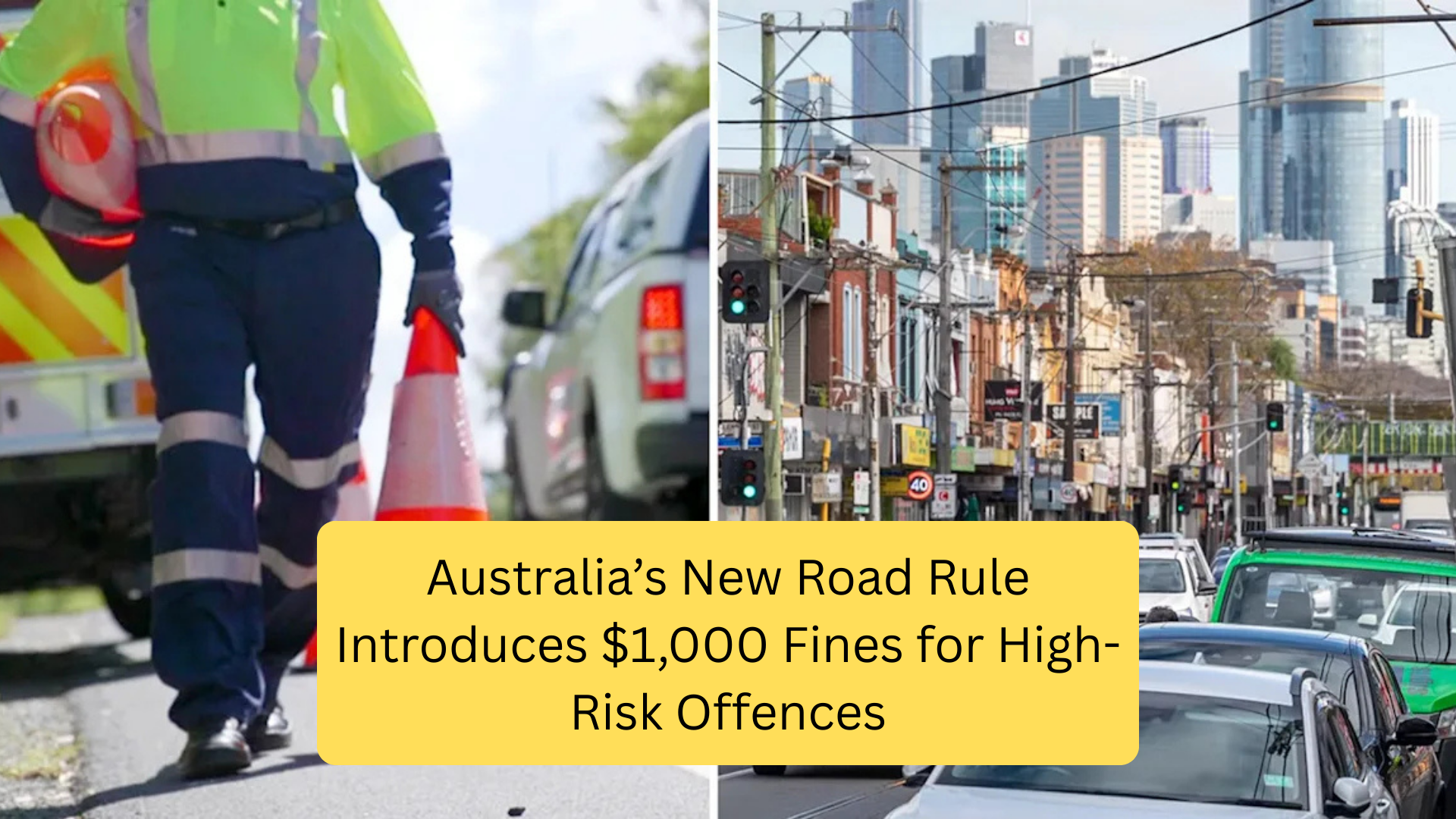
Imagine you’re traveling at highway speed and encounter an emergency vehicle—a fire truck or an ambulance—pulled over on the side of the road, lights flashing. The instinct might be to continue cautiously, but under Australia’s New Road Rule, this action could result in an instant fine of up to $1,000. The introduction of severely increased penalties for high-risk behaviors marks a decisive, yet controversial, turning point in the nation’s road safety strategy, sparking intense public debate.
The nationwide legislative shift targets high-risk road behaviors that put emergency responders and vulnerable road users at direct risk. These include dangerous overtakes, failure to yield to emergency vehicles, and—critically—failing to slow down and move over when passing certain stationary vehicles. The new penalty structure, which sees fines for these offenses reaching four figures, is designed to be a powerful deterrent across every state in Australia. While road safety advocates applaud the move, many drivers feel the enforcement is excessive and confusing.
Background: The Rising Risk to Emergency Responders
The catalyst for Australia’s New Road Rule is the escalating number of near-misses and serious injuries sustained by emergency and roadside assistance personnel. When police, ambulance officers, or tow-truck operators are working on the roadside, they depend entirely on passing drivers to exercise extreme caution. Tragically, statistics from the past five years show a worrying trend: incidents involving these workers have increased by 15% across Australia.
The primary motivation behind the New Road Rule is to save lives and protect those who protect others. The government has concluded that existing fines were insufficient to deter what is often casual negligence at high speeds. Therefore, a massive increase, culminating in the $1,000 Fines Coming for High-Risk Violations, was deemed necessary to immediately change driver culture and ensure compliance with “move over” laws. The sheer scale of the penalty is intended to force drivers to pay attention.
The change signals that the responsibility for safety around roadside incidents lies squarely with the moving motorist. This zero-tolerance approach under Australia’s New Road Rule reflects a strategic commitment to reducing the national road toll, which has stubbornly hovered around a critical threshold despite previous interventions.
What’s New: Key Changes in High-Risk Penalties
Australia’s New Road Rule introduces two primary areas of focus where the fines have been dramatically uplifted to the $1,000 level, making them some of the most expensive non-speeding infractions in the country.
Key changes related to high-risk violations:
- Failure to Slow Down and Move Over: This is the most significant change. Drivers must now slow to a specified speed (often 40 km/h or 25 km/h, depending on the state and zone) and, if safe, move over to the furthest lane when passing stationary emergency vehicles with flashing lights (police, ambulance, fire) or certain designated roadside assistance vehicles (tow trucks, breakdown services). Failure to comply can now incur the $1,000 Fines Coming for High-Risk Violations.
- Dangerous Overtaking: Penalties for dangerously overtaking vehicles, particularly those operating in school zones, road work zones, or vehicles stopped to allow pedestrians to cross, have been drastically increased. This includes crossing solid lines to pass where visibility is limited, or passing too close to cyclists.
- Increased Demerit Points: Alongside the financial penalties, the number of demerit points associated with these high-risk violations has also increased, often reaching 6 or 7 points, significantly raising the risk of license suspension for repeat offenders.
- Broader Definition of ‘Vulnerable User’: The New Road Rule has codified stricter protections for vulnerable road users, including cyclists, motorbikes, and pedestrians, penalizing close calls or aggressive driving behavior near them with the threat of the $1,000 Fines.
The Human Angle: Confusion and Financial Shock
The immediate backlash to Australia’s New Road Rule has largely centred on complexity and the shock of the four-figure fine. Many drivers, particularly those who rely on high-volume traffic corridors, find the “slow down and move over” rules confusing, especially in heavy traffic or on multi-lane highways where moving over is sometimes impossible.
“I was driving home on the M1, and there was a police car helping someone change a tire on the shoulder. Traffic was bumper-to-bumper,” explained Mr. Thomas Lee, a 45-year-old software sales representative from Sydney. “I couldn’t move over because of the lane beside me, and I was terrified of braking suddenly because of the traffic behind me. You feel trapped. If I get hit with a $1,000 Fine for being safe in my own lane, that’s going to cause real financial stress for my family in Australia.”
Mrs. Jennifer Patel, a school teacher and single mother, voiced her concern about the financial impact. “A thousand dollars is an entire month’s worth of groceries. This isn’t a minor penalty anymore; it’s catastrophic. It makes me question if I should even drive during the holidays, just to avoid the risk of misunderstanding Australia’s New Road Rule.” The fear of the severe financial shock is clearly designed to generate compliance, but it is also creating widespread anxiety.
Official Statements and Clarification
Road safety authorities and government officials are standing firm on the necessity of the New Road Rule and the severity of the $1,000 Fines Coming for High-Risk Violations. They argue that the safety of emergency workers is non-negotiable and requires exceptional deterrents.
“We understand that Australia’s New Road Rule represents a significant shift, and yes, the fines are severe,” stated Commissioner Alan Davies of the State Traffic Enforcement Division. “However, our personnel should not have to risk their lives to perform their jobs. The evidence is clear: reducing speed and increasing the lateral distance between a moving vehicle and a stationary emergency vehicle saves lives. The $1,000 Fine reflects the severity of the risk posed when drivers fail to adhere to this basic safety mandate.”
Commissioner Davies confirmed that extensive public awareness campaigns are underway to educate drivers on the specifics of Australia’s New Road Rule, particularly clarifying the exact speed reduction and moving over requirements for different road types. He stressed that a high degree of common sense and caution must now be applied by every driver in Australia.
Expert Analysis: Data Insight and Behavioral Change
Transport psychologists believe the move to introduce the $1,000 Fines Coming for High-Risk Violations is a classic case of using behavioral economics to enforce public safety. The sheer magnitude of the penalty is expected to dramatically increase the perceived cost of non-compliance.
Dr. Eleanor Voss, a behavioral safety expert, noted the effectiveness of such high-value penalties. “When a penalty jumps from, say, $300 to $1,000, it moves from being an inconvenience to being a catastrophic financial event for many families in Australia,” Dr. Voss explained. “This changes the internal calculation a driver makes in that split second. It forces the pre-frontal cortex to override habitual actions. We anticipate a drop of 40% in targeted dangerous overtaking offenses within the first six months simply due to the fear of the $1,000 Fine.”
Dr. Voss also highlighted a critical statistic: an increase of just 10 km/h in speed when passing an emergency zone increases the likelihood of a catastrophic incident by 25%. This data strongly supports the mandated speed reduction requirement under Australia’s New Road Rule.
Comparison: $1,000 High-Risk Fines vs. Other Penalties
The introduction of the $1,000 Fines for high-risk, non-speeding violations places these offenses among the most heavily penalized traffic infractions in Australia. This comparison table illustrates how these newly defined high-risk acts are now being treated with the utmost seriousness, often exceeding the penalties for certain reckless speeding incidents.
| Offence Category | Fine (Example State) | Demerit Points | Severity Level |
|---|---|---|---|
| Fail to Move Over/Slow Down (New Rule) | $1,000 | 4-6 | Extreme Risk |
| Using Mobile Phone (Illegal Handheld Use) | $415 | 5 | Very High Risk |
| Excessive Speed (20-30 km/h over limit) | $481 | 4 | High Risk |
| Failing to Stop at School Crossing | $580 | 3 | High Risk |
| Reckless Driving / Hooning Offences | Up to $2,200 | 8+ | Major Criminal Offence |
The data confirms that the $1,000 Fines Coming for High-Risk Violations are specifically designed to shock drivers into compliance. They sit just below criminal-level reckless driving offenses, signalling the government’s view that ignoring the safety of roadside workers is an act of extreme negligence.
Impact and What Readers Should Do
The impact of Australia’s New Road Rule is immediate and demands proactive education from all motorists. The days of treating police cars or tow trucks on the roadside as a minor inconvenience are over. The potential for a $1,000 Fine requires complete attention and adherence to the new rules.
Action Step 1: Learn the Local Speed Limit: The “slow down” requirement varies. In some states, it is a compulsory 40 km/h in urban areas or on roads with lower speed limits, while on high-speed motorways, the rule often dictates moving over one full lane. Drivers must check the specific requirements for their state in Australia. Action Step 2: Create Distance: If you see flashing lights ahead, slow down well in advance. Create as much lateral space as possible between your vehicle and the stationary vehicle, regardless of whether it is an emergency vehicle or a road-assist vehicle. Action Step 3: Never Guess: If you are unsure whether you need to move over due to heavy traffic or dangerous road conditions, prioritize slowing down dramatically. The penalty for failing to slow down is just as severe as the penalty for failing to move over.
Australia’s New Road Rule and the introduction of the $1,000 Fines Coming for High-Risk Violations represent a necessary, though punitive, step toward protecting emergency and roadside service personnel. While the steep penalty has caused a public backlash, its effectiveness as a deterrent is expected to be profound. The takeaway for every driver in Australia is simple: extreme caution and adherence to the “slow down and move over” principle are now legal mandates. A momentary lapse could result in a crippling $1,000 Fine, making vigilance the best defense against both the law and the inherent dangers of the road.






Leave a Comment