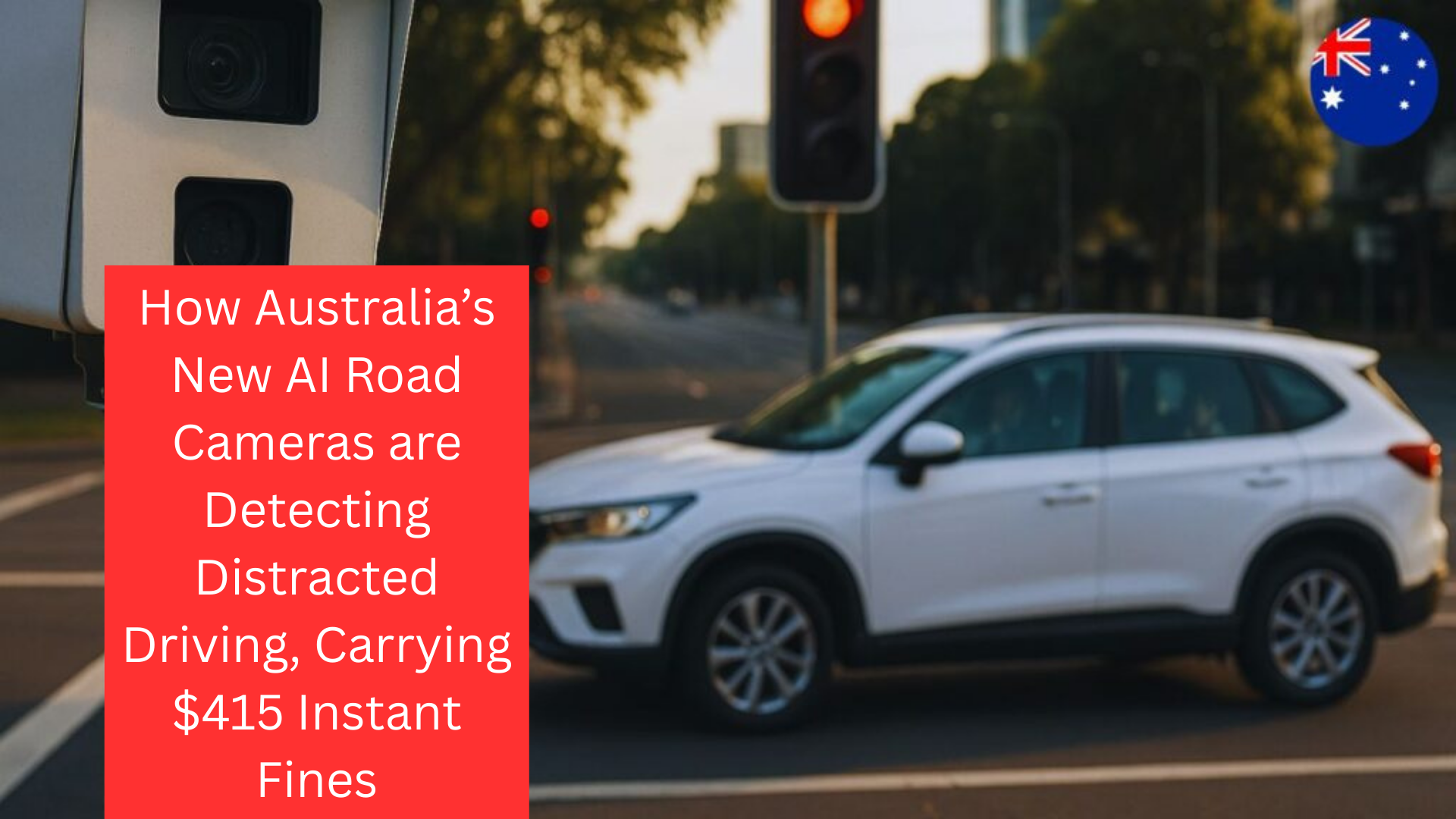
Imagine momentarily resting your elbow on the steering wheel, or glancing down at your mobile phone—a split-second lapse—only to find an official notification waiting for you in the mail days later. This scenario is set to become an immediate reality for drivers across Australia as a comprehensive network of New AI Road Cameras begins issuing steep financial penalties this summer, carrying an instant fine of up to $415.
The nationwide rollout of these sophisticated New AI Road Cameras represents a major shift in traffic enforcement strategy. Instead of relying solely on traditional speed or red-light detection, these high-tech systems are specifically designed to detect illegal mobile phone use and seatbelt violations from both drivers and passengers. The operational start date, scheduled for the peak summer months, aims to maximize impact during the busiest driving season across Australia.
Background: The Need for Automated Enforcement
The introduction of the New AI Road Cameras is fundamentally driven by alarming road safety statistics related to in-cabin driver distraction. Despite extensive awareness campaigns and existing legislation, the use of handheld mobile devices while driving remains a persistent and deadly contributor to serious crashes in Australia. Studies show that driver reaction time is significantly slower when distracted, equivalent to driving under the influence of low-level alcohol.
Furthermore, these New AI Road Cameras address the persistent issue of low-level, non-compliance safety issues like unbuckled seatbelts—a violation that often goes unreported due to the difficulty of enforcement by patrol officers. The government’s clear objective is not revenue generation but casualty reduction, making these cameras a necessary, though controversial, tool in achieving zero road deaths across Australia. The high $415 Instant Fines reflect the severity of the offenses being targeted.
The technology has been trialled successfully in select jurisdictions, demonstrating a high accuracy rate in distinguishing between legal actions (like touching a radio) and illegal actions (like holding a phone to the ear). This precision is vital for the credibility of the New AI Road Cameras system as it expands its reach throughout the country.
What’s New: Key Changes in Technology and Penalties
The shift from sporadic, human-dependent enforcement to constant, automated surveillance is the key change. These New AI Road Cameras operate 24 hours a day, seven days a week, processing millions of vehicle images weekly. This continuous monitoring drastically increases the perceived risk of being caught for the offenses of mobile phone use and not wearing a seatbelt.
Key features of the New AI Road Cameras and the associated penalties:
- Infrared and High-Definition Imaging: The cameras use advanced, high-resolution lenses paired with infrared technology. This allows them to capture clear, actionable evidence of in-cabin offenses even in poor weather, at night, or through tinted windows.
- Machine Learning (AI) Processing: The AI component rapidly scans the images to identify specific behaviors—such as the shape and position of a mobile phone being held—and filters out millions of compliant images. Only potential violations are flagged for human review before a fine is issued.
- The $415 Instant Fines: While the exact penalty varies slightly between states, the maximum infringement for illegal mobile phone use starts around $415 and can be accompanied by up to five demerit points. Seatbelt violations carry similar severe penalties, reinforcing the seriousness of non-compliance.
- Grace Period (Varies): Some jurisdictions implementing the New AI Road Cameras have initially offered a temporary grace period, issuing only warning letters. However, this period is expiring or has already expired in many regions, meaning the $415 Instant Fines will be actively issued starting this summer.
- State-by-State Rollout: While the technology is nationally coordinated, the precise location and timing of the camera activation will differ by state, though the policy intention is full coverage across major arterial routes in Australia by the end of the year.
The Human Angle: Catching Drivers Off Guard
The arrival of the New AI Road Cameras is changing driver behaviour, sometimes uncomfortably. For many long-term drivers, the habit of quickly checking a text message at a red light is deeply ingrained, and they are now realizing the full financial jeopardy of that habit. The swiftness of the fine system has caught many drivers off guard, emphasizing the instantaneous nature of the penalty.
Mr. Kevin Davis, a 55-year-old delivery driver in Queensland, received a warning notice during the initial trial phase. “I was holding my coffee mug, and the AI mistook it for a phone. Luckily, a human reviewed the image and dismissed it,” Mr. Davis recounted. “But it was a wake-up call. Now I’m extra paranoid about even scratching my face or adjusting my glasses. The $415 Instant Fine risk is too high, especially for essential workers like me in Australia who spend all day on the road.”
The focus on seatbelt enforcement also has a human dimension, particularly for passengers. Ms. Lena Petrov, a university student in Melbourne, learned this the hard way. “My friend was driving, and I had undone my seatbelt for literally ten seconds to reach for something in the back seat. We got fined $415,” she explained. “It seems harsh, but I guess it works—I won’t ever unbuckle while moving again, which is the point of the New AI Road Cameras.”
Official Statements and Procedural Integrity
Road safety authorities are determined to push back against the perception that the New AI Road Cameras are simply a new tax on motorists. Official statements consistently frame the enforcement as a critical tool for saving lives, justifying the severity of the $415 Instant Fines.
“Our modelling indicates that the presence of these New AI Road Cameras across Australia will reduce mobile phone-related fatalities by over 20% within the first two years of full operation,” stated Ms. Sarah Lindholm, Director of the National Road Safety Commission. “We know the fines are significant—they have to be. Distraction is now on par with speeding as a top killer on our roads, and it demands this level of automated intervention.”
Ms. Lindholm confirmed the procedural safeguard: “Every single infringement flagged by the AI is manually reviewed by a trained officer before a fine is issued. The AI system acts as a filter, not the final decision-maker. This is critical to ensure fairness and accuracy for every driver in Australia subjected to the New AI Road Cameras’ surveillance.” The authorities maintain that the accuracy rate is industry-leading, building confidence in the rollout.
Expert Analysis: Data Insight and Public Acceptance
Transport policy experts note that while there is initial public resentment regarding the perceived surveillance and the size of the $415 Instant Fines, these New AI Road Cameras represent the inevitable future of road safety management. The technology offers consistency and eliminates human bias, leading to more equitable enforcement.
Dr. Kenji Tanaka, a specialist in transport technology and ethics, emphasized the data. “Human error is a factor in approximately 85% of all serious road crashes globally,” Dr. Tanaka pointed out. “If these New AI Road Cameras can eliminate the fatal factor of distraction, the social benefit far outweighs the perceived loss of privacy. The sheer visibility and constancy of the surveillance are what eventually change the dangerous habits of drivers in Australia.”
The immediate impact of the technology is undeniable. In the initial trial sites, there was a recorded decrease of 78% in detected mobile phone offenses within the first three months of issuing fines, providing compelling evidence of the behavioral change prompted by the risk of the $415 Instant Fines from the New AI Road Cameras. This demonstrates that drivers respond quickly to high-certainty, high-penalty enforcement.
Comparison: AI Camera Fines vs. Other Major Offences
To put the $415 Instant Fines issued by the New AI Road Cameras into perspective, it is useful to compare them against other common and serious road safety infractions in Australia. This comparison highlights the government’s classification of mobile phone use and seatbelt violations as severe, high-risk behaviors.
| Offence Category | Fine (Example State) | Demerit Points | Classification of Severity |
|---|---|---|---|
| Illegal Mobile Phone Use (Handheld) | $415 | 5 | Very High Risk (Target of AI Cameras) |
| Failing to Wear Seatbelt | $397 | 3 | Very High Risk (Target of AI Cameras) |
| Low Range Speeding (10km/h over) | $183 | 1 | Moderate Risk |
| Driving Through Red Light | $464 | 3 | High Risk |
| Unsafe Lane Change | $283 | 2 | Moderate Risk |
The data table clearly shows that the $415 Instant Fines associated with the New AI Road Cameras place these distraction and compliance offences in the highest tier of penalties, alongside major offences like running a red light. This confirms the government’s unwavering commitment to treating distraction as a life-threatening, critical violation across Australia.
Impact and What Readers Should Do
With the New AI Road Cameras moving from trial to full enforcement this summer, every driver in Australia must adjust their habits immediately to avoid the steep $415 Instant Fines. The cameras provide no human judgment, so the margin for error has effectively been eliminated.
Action Step 1: Secure Your Phone: Before starting the car, ensure your mobile phone is either placed in a dedicated cradle (for approved navigation use) or secured completely out of reach—in a bag, glove box, or the centre console. The AI will detect any phone being held while driving. Action Step 2: Full Compliance: Ensure all occupants, including backseat passengers, are correctly restrained with their seatbelts fastened before the vehicle moves. The New AI Road Cameras are designed to check all visible passengers for seatbelt compliance. Action Step 3: Review the Evidence: If you do receive a fine from the New AI Road Cameras, remember that the enforcement is based on captured images. You have the right to request and review the photographic evidence taken by the system before deciding whether to pay or challenge the $415 Instant Fine.
The introduction of the New AI Road Cameras system across Australia signifies a permanent shift toward automated, high-certainty enforcement. While the size of the $415 Instant Fines may cause frustration, the overall goal is to eliminate preventable tragedies caused by in-cabin distraction. The safest and most economical strategy for every motorist this summer is simple: keep your hands on the wheel, your eyes on the road, and your phone securely away. The technology is here to stay, and compliance is the only defense.










Leave a Comment